Negative electrical inspection report: how to read it and understand the breaches
Twelve pages of RGIE jargon, usually in French or Dutch, and a red “NON CONFORME” stamp that does not tell you what to do. Here is how to decode your report, line by line, whichever body wrote it. We work in English.
Vinçotte, Certinergie, Normec BTV, ACA, Belgotest, Apragaz, Enercetec... each approved inspection body lays out its report in its own way, but they all follow the same structure set by Book 1 of the RGIE. Once you understand that structure, you can read any report, whoever issued it.
How to read your report, section by section
Identification and general data
At the top of the report: the address inspected, the date of the visit and the approved body. Just below, a series of technical data (earthing, voltage, number of consumer units...): this is descriptive, these are not breaches.
The results table
Several bodies, Certinergie in particular, first show a summary table with “Pas OK” (not OK) next to some measurements. It is a quick summary: the full list, with the RGIE articles, comes right after.
The list of breaches
The part that really matters. Each line refers to an article of Book 1 (for example 5.3.5.2 or 4.2.2.3), so your electrician knows exactly which rule to fix, with no ambiguity.
The conclusion and the deadline
The final verdict, and the deadline to bring things up to standard: 12 months in general, 18 months for installations from before 1 October 1981. The exact rules are explained here.
Separately: the “remarques” (remarks). Unlike breaches, they do not affect the outcome of the inspection; they simply flag a point of attention (furnished property, limited access to the consumer unit, etc.).
The 6 breaches found in almost every report
In the reports our clients send us, these six breaches come up almost every time, whatever the inspection body or the municipality.
e.g. a consumer unit as we often find it on a first visit
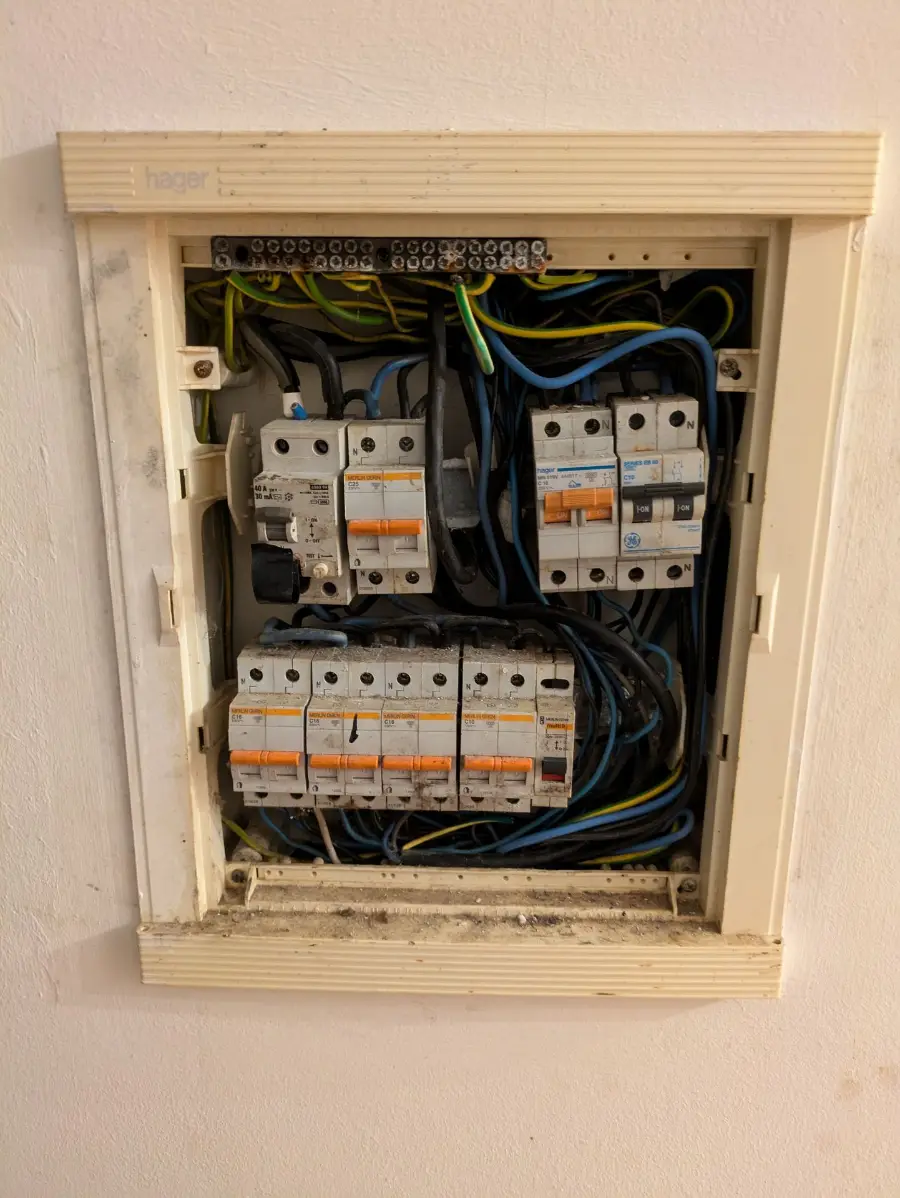
Missing diagrams and plans
What the report says: « Schéma unifilaire non présent » (single-line diagram missing), « Plan de position non présent » (position plan missing).
In plain English: the single-line diagram shows which breaker protects which circuit; the position plan shows where each socket and switch is. Without these two documents, the inspection is automatically negative, even if the installation itself is flawless.
To fix it: we draw them up during the technical visit, based on your actual installation.
Voltage not shown on the consumer unit
What the report says: « La tension d'alimentation n'est pas indiquée clairement sur le tableau » (the supply voltage is not clearly shown on the consumer unit).
In plain English: a label (230V, 400V...) must be durably fixed on each consumer unit. It seems trivial, yet it is one of the most common breaches.
To fix it: a few minutes: a regulation label on each consumer unit.
Earthing and PE continuity
What the report says: « La continuité du PE vers les contacts de terre des socles de prise n'est pas réalisée » (no protective earth continuity to the earth contacts of the sockets).
In plain English: every earthed socket, and every class I appliance (washing machine, oven, hob...), must be electrically connected to the earth conductor. Without that continuity, the earth does not protect you in case of an insulation fault.
To fix it: the earth connections on the affected sockets and circuits are redone.
Residual current device that does not trip
What the report says: « Le dispositif de protection à courant différentiel-résiduel ne fonctionne pas après avoir actionné le bouton test » (the residual current device does not work after pressing the test button).
In plain English: the residual current device (RCD) must cut the power within a fraction of a second if there is a leak. The inspector tests it physically. If it does not react, or if there is none at the origin of the installation, your main protection against electric shock is missing.
To fix it: the device is replaced, or a main RCD is added if there is none.
Insufficient protection (IPXX-B)
What the report says: « Le degré de protection n'est pas au moins égal à IPXX-B » (protection rating below IPXX-B), « il manque des obturateurs dans le tableau » (blanking plates missing in the consumer unit).
In plain English: a consumer unit without a cover, an empty slot without a blank, a broken socket or switch: anything that leaves an electrical contact reachable with a finger falls under this breach.
To fix it: covers and blanking plates are fitted, damaged fittings replaced.
Fixing and connections
What the report says: « Interrupteur(s), socle(s) de prise et/ou boîte(s) de dérivation ne sont pas fixés correctement » (switches, sockets and/or junction boxes not properly fixed).
In plain English: a socket that moves in the wall, twisted wires in the open outside a junction box, a connection that does not follow good practice.
To fix it: fixings are put right and connections redone in standard junction boxes.
Once you have your report
You do not have to find an electrician for each line of the report yourself, or chase the inspection body. We take your full report, plan a technical visit and handle everything until your new certificate, including booking the re-inspection. You have 12 or 18 months, depending on the age of your installation, to bring it up to standard. If you use this work to install an EV charger, we handle both in a single job and a single visit by the approved body.
What people ask us most when reading a report
In the vast majority of cases, no: you can carry on living normally at home while the work is scheduled. An RGIE breach flags a gap with current standards, not necessarily an immediate danger. If a point in the report particularly worries you, call us and we will give you a clear opinion.
Every installation is different, and a report can have dozens of lines. Send us your report by email or WhatsApp and we will explain each point, even before the technical visit.
Some points are within your reach: sticking on a voltage label, closing an opening with a blank. Others directly affect safety (earthing, RCD, consumer unit) and must be done by a professional and then approved by the inspection body. If in doubt, ask us.
No, except in rare cases where the report explicitly requires it. In general, you are free to choose the approved body for the re-inspection. That is exactly what we arrange for you.
“An inspection report that scares you shouldn't. Once you know how to read it, it is a list of things to fix, full stop. That is our job.”